Thoughts on children's stories.
16 Feb, 2026
Sara,
I have not been able to stop thinking about a story you told us during last week’s lecture. Not a myth, a story, you’d said, that was important.
You’d told us about a tribe of ancient peoples who had raised a girl who was gifted, in that she could talk with the mountains and trees. I do not remember whether the source of this gift was divine, or passed down within the tribe, or even if there was a meaningful distinction between the two. I do not remember the name of this tribe, or, as I think on it longer, what connection they might have had to you, a tribal member, our professor.
Getting this (likely traditionally spoken) story down in my own words, now, I can’t help feeling like I’m mangling it. Still, I’m a better writer than I am a speaker. Writing things down is how I remember them, and I would like to remember the story you told us.
The mountains and the trees spoke to the girl of an imminent disaster, which concerned everyone. I think, by the time of this telling of the story, the details of the disaster are lost, or, alternatively, we’re living them today. I don’t remember you outright suggesting this, and, in the end, I don’t remember the disaster being the point. The part of the story that’s been wedged into the back of my mind, since hearing it, is the peoples’ response to the mountains, the trees, and the girl’s foretelling.
The somewhat doomed tribe listened, and, having come to terms with the situation, split itself down the middle. Half of its people would carry on into the future, towards the disaster, armed with a heads-up. The other half was sent back into the past, where they’d become the mountains, and the trees, the natural world that was the tribal peoples’ home, and eventually warn them of a coming disaster.
This is what has been occupying me, on and off, for the last week, as well as some lingering, scolding sentiment towards myself for not taking notes, and possibly missing crucial details that you spoke, giving life to the real story.
Still, what a rich story it is. Even my version.
Ultimately, it’s an origin story, or what some would call a “creation myth.” It rings with spiritually satisfying ideas of oneness, nature’s cycles, and even a potentially great, looming evil. (Drama!) At least to me, it does. But what most tickles my own, personal fancy, is that it’s simultaneously an explanation of how we got here, and where we’re going, that poses more questions than answers.
I think the point of the story is to communicate what the world is like. It feels, to my foreign feelings, like an onboarding to a weird and wonderful world in which cause and effect have a two-way relationship, and the past holds the future. It feels, to me, like the perfect parable to level at a kid asking “Why?”
This is some of the subtext I like from the story you told us. But it’s not just a lesson. It’s a narrative that describes things that literally happened, in a time before things were so literal… Maybe truth can’t be spoken without ulterior motives.
There’s a different kind of knowledge present here than in, say, the Big Bang Theory, (not the show) although some of the takeaways to be gleaned are not so different. We all come from the same place, and we all return there. And you’ve told us both astronomy and indigenous traditions understand we’re made of stars. How about: studying versus consuming fungi can end us up with similar teachings about where we go when we die. This is the stuff master’s degree programs are made of, and the sort of abstract thought accessible to anyone who’s played Zelda. If you know, you know.
Lastly, this story feels to me like a great prelude, or an introduction.
I’m really excited to continue with you, as we work on this book.
Henry
30 Aug, 2026
A story is only as good as its ability to reach deep into and affect something inside of its reader. I believe this.
Now, most children's stories, unrelated to their goodness, when read young enough, will change their readers forever.
These are some of the things I've been thinking about while writing my children's book.
Does this mean that it's easier to write for kids than for adults? I don't... think so. I don't think I think so. I think it means more than anything that a story is just another one of those very subjective things… although, subjective, hm. "For kids" and "subjective" are both loaded terms. When somebody tells you a movie is "for kids", what they might really be implying is that the movie's simple, shallow, or just not very good. If, after an art opening, your friend says the greatness of the work on display was "subjective", you might understand them to be saying that it wasn't undeniable, not truly all that great.
There's been an online discourse lately likening mindless ("brain rot") kids' entertainment to the jangling of keys in baby's face. Baby is happy, keys need only be jangled. Whatever. Somewhat similarly, there's a never-ending questioning of the highly subjective experiences that can be had with some fine art. Oh, great, Jackson Pollock's just flicked paint all over the place. Well, worse. He's just jacked off. He’s jangling. Which is maybe a problematic comparison to include in a paragraph that started with happy babies, but one I think gets at something real. Art that's merely "for kids" and art that's merely "subjective" is a perversion, on some level. Degenerate, brain rot, even. Bad. Most charitably, not to be experienced with the mind.
But who possesses the highest capacity to fall, completely rapt, into a story? Children. And what is the only plane on which art is really able to affect us? The subjective, personal. Art and storytelling are some of the oldest, most important, human conversations. But for each human, the conversation has to start somewhere. The things we're shown as kids are our first models of the world. Everything that follows will respond to the expectations formed from these most subjective, inner experiences.
Check out the first things that come up when I look up "subjective":
2. Based on a given person's experience, understanding, and feelings; personal or individual. "admitted he was making a highly subjective judgment."
3. Not caused by external stimuli.
Well, that's where the bar’s been set, and it's the only possible means by which your audience can connect to your work.
So, sure, sounds easy to come up with a good children's story.
Because of the nature of my project, (a children’s book, which works on multiple artistic levels, and communicates something social-justice flavored to its young audience) creating this connective, human experience was my biggest concern. (I say “my” when I mean “our”– this was a two person project, but it’s also my final for this class, and I don’t want to speak for my partner Freddy’s exact thought process.)
The underlying Indigenous themes of this class, to my understanding, are as follows:
(Spoken from my own perspective as an outsider to these ideas)
This way of living has been successfully practiced for much longer than our current, dominant way, because it’s sustainable, and much wiser.
This other, more deeply-rooted way of living is very different to ours, and can be observed in noncolonial, Indigenous traditions around the world.
This other way can seem illogical, unscientific, and primitive to people who do things the dominant way, but it’s actually made up of countless, timeless, interlocking systems that account for human nature, the natural world, and sacred relationships.
Because the other way exists in harmony with these dynamics, good things like reciprocity, sustainability, and shared wisdom naturally emerge.
Because the dominant way consistently suppresses and exploits human nature, the natural world, and sacred relationships, it erodes many of those aforementioned good things.
The other way isn’t something to be fetishized as a beautiful, virtuous relic of the past, it’s simply what’s lasted this long because it’s always worked, and always will.
The other way works for the same reasons the rest of the natural world works.
Part of keeping my young reader engaged with the story and thinking critically was connecting with her on that subjective, experiential level. To me, that meant incorporating a little edge. Some pretty messed up stuff happens, but nothing is more messed up than the twist at the end: the bipedal rabbitfolk, in their concrete buildings and steamrollers, destroy the swamp where the little girl adventures. This is hopefully a shocking, thrilling moment– I know it’s worked when I see an unsettled smirk on my reader’s face. “Can that happen in a children’s book? Was I supposed to see that?” In swinging for the fences a little, I hope the book feels somewhat alive, a co-conspirator asking: “What are you gonna do about it?”
My (work in progress) method for writing a good children’s book (I want to make more) involves playing with the ideas that are interesting to me in a format that could reasonably make it into a kid’s hands undetected. If my reader and I both feel like we got away with something, and in the process had a conversation we both took seriously, I think we’re coming away satisfied.
I want to push this style further, and the things we covered in your class really re-filled me with an urgency to get more of this sort of work out there. No key jangling. The world is fucked up and awesome, and hopefully my books fuck up the next generation, forever.
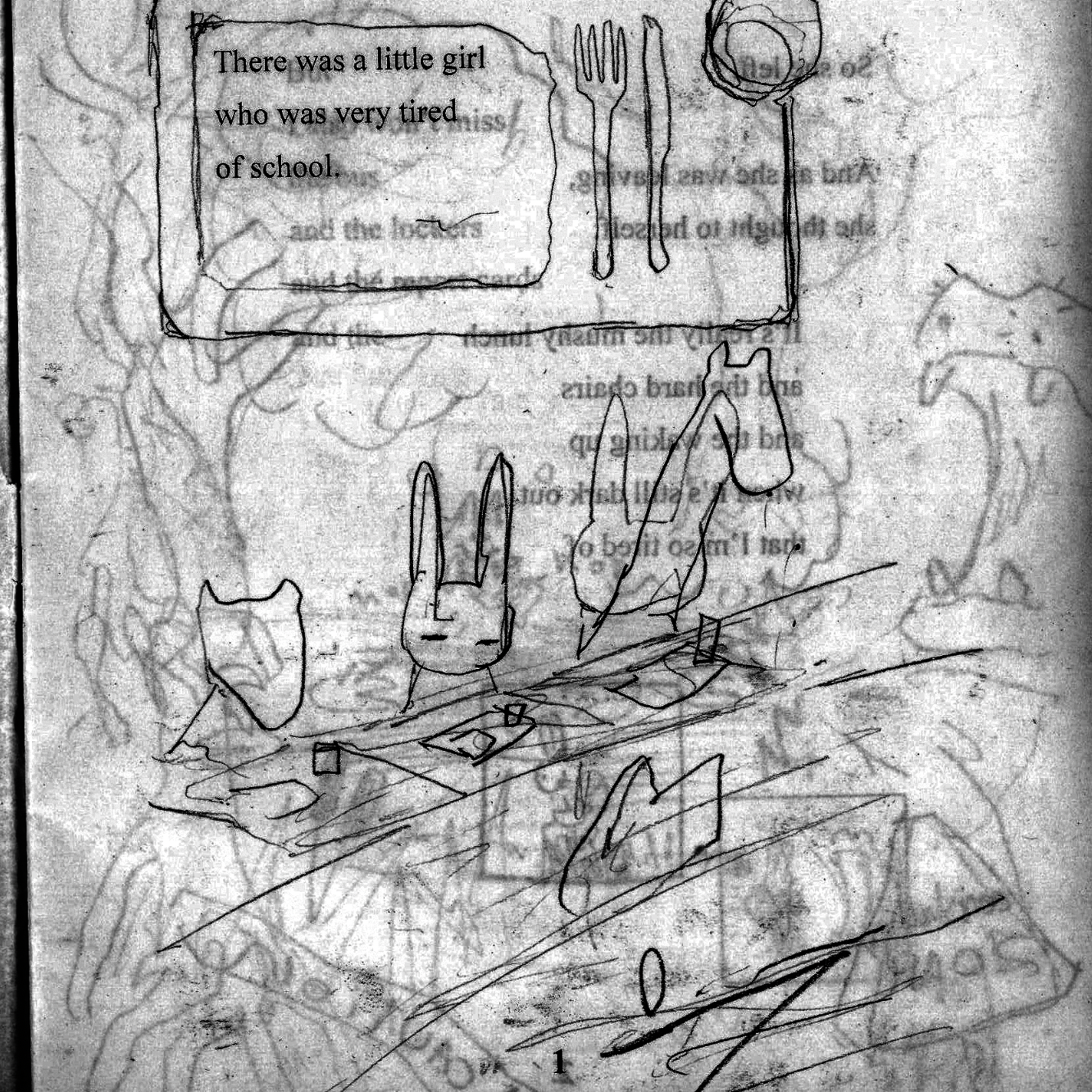
releasing Summer 2026 through moonrabbits.net.
More stories worth studying...
Bubbles (not for kids)
Ishmael
Zen Koans: The Questions That Were Never Meant to Be Answered
Story Club with George Saunders